You are scrolling up a chat on a Sunday night, and you notice the pattern before you mean to. Every grey bubble on the left is a reply. Every blue bubble on the right is you starting something. The walk at Safa Park in October: you suggested it. The coffee in Al Quoz afterwards: you again. The board-game night where she laughed so hard she had to put her cards down: your idea, your table booking, your reminder on the day.
She always comes. She always seems glad to be there. She has never once asked first. And somewhere between the third and fourth blue bubble, a small, unkind question has started to form. Does she actually like me, or is she just being polite?
This is one of the most common quiet worries in grown-up friendship, and one of the least talked about. It is also, much more often than it feels, not the verdict you think it is.
Why one person nearly always goes first
Almost every new friendship is lopsided at the start. Someone has to suggest the first coffee, and whoever did that tends to end up suggesting the second, and the third, until a habit has set without anyone deciding it. The other person is not keeping score. They have simply learned that plans arrive, and that you are good at them.
That is worth sitting with before you conclude anything. You noticed the pattern because you were the one doing the work. They may not have noticed at all, in the same way that people who never cook rarely notice who does the shopping.
The three ordinary reasons behind it
The first is plain busyness. Dubai is a city of long hours, commutes from Sharjah or out past the Marina, and families on the other side of the world who need a call at awkward times. Plenty of people have room for friendship but no room to organise it. They will say yes to a good plan on Thursday. They will not sit down on Monday and invent one. If that sounds familiar, there is more on making friends when your working week eats everything.
The second is style. Some people are initiators by nature: they think in plans, they enjoy the arranging, and a free Saturday feels like a question to be answered. Others are responders. They are warm and loyal and entirely pleased to see you, but it genuinely does not occur to them to be the one who starts. Neither is better. It just means that two responders rarely become friends at all, and an initiator paired with a responder can look one-sided from the inside while working perfectly well.
The third reason is the most Dubai of all. People here assume everyone else is booked. You look sociable, you seem settled, you clearly know people, so the other person decides you must have plenty going on and would not want to be bothered. Newcomers especially tend to believe that everyone who has been here longer already has a full circle. Very often, the person you keep inviting is sitting at home thinking how nice it is that you make time for them, given how busy you must be.
A slow friend or an uninterested one?
There is a real difference, and it usually shows up in the details rather than in who sends the first message.
A slow friend says yes more often than no, and when they say no, they tend to offer another time. They turn up, and they turn up properly: phone away, asking about the job interview you mentioned last time, remembering your sister's name. They reply to your messages, even if late. Now and then they send you something unprompted, a photo of a café they think you would like, a link, a joke. They are not planning, but they are clearly thinking of you.
An uninterested person looks different. The yeses are vague and the cancellations are frequent, with no alternative offered. Messages go unanswered for a week and come back with a thumbs-up. When you do meet, the conversation stays on the surface, or runs entirely in one direction. Nothing ever arrives from their side, not even the small things that cost nothing.
It is also worth being honest about time. Research by Jeffrey Hall at the University of Kansas suggests it takes around 50 hours together to move from acquaintance to casual friend, around 90 to become a friend, and well over 200 for a close one. If you have had four coffees, you are perhaps six hours in. Early lopsidedness at hour six says very little. The arithmetic of friendship is slow for everyone.
One honest, light test
If you have spent a couple of months carrying a friendship and you still cannot tell, there are two gentle ways to find out. Pick one. Neither needs to be dramatic.
The first is simply to stop initiating for a while. Not as a punishment and not as a sulk, just as a pause. Let three or four weeks go by without sending the plan. You may be pleasantly surprised: plenty of responders, noticing the quiet, reach out with a slightly sheepish "been ages, are you around this weekend?" Others will say nothing, and that tells you something too, though not necessarily everything. Some people drift simply because nobody picked up the thread, which is exactly how most friendships fade.
The second way is to say it, kindly and lightly. Not "why do I always have to organise everything", which is an accusation, but something with a smile in it: "I love our walks. Next time you pick the place, I always end up choosing." Or: "I'm terrible at knowing whether people want to be asked. Tell me if I'm being too much." Most people respond to that with relief and, quite often, a plan. It gives a responder permission to step forward, and it gives an uninterested person an easy, friendly way out.
Either way, you learn more in a month than you would in a year of quietly wondering.
When to invest elsewhere, without bitterness
Sometimes the answer is that they are not all that interested. That stings, but it rarely means anything is wrong with you. People arrive in friendships with different amounts of room. Someone newly in love, someone with a baby, someone about to leave Dubai, someone who already has a tight group from school back home: all of them can like you perfectly well and still have no space to build something new.
The anthropologist Robin Dunbar has described friendship in layers, roughly five people closest to us, then fifteen, fifty and a hundred and fifty, and has noted that friendships which do not get contact tend to slide outwards over time. That cuts both ways. It means your effort was never wasted, and it means you are allowed to spend your limited hours where they are returned.
So let the friendship settle to whatever size it naturally is. A person who will happily come to a board-game night twice a year, and whom you are glad to see, is still a good thing to have in your city. You do not need to announce the change or close any doors. You simply stop pushing, and put the energy you were spending into someone who answers back.
Why being the initiator is a gift
Here is the part people forget when the blue bubbles pile up. Being the one who starts things is not a weakness. It is one of the most valuable roles in anyone's social life, and in a city where so many people are waiting to be asked, it is rarer than it should be.
Think about your own closest friendships. Quite often there is one friend who simply refused to let you drift: who kept suggesting the Saturday walk, who remembered the birthday, who said "come on, it's only an hour" when you were about to cancel. You probably think of that person with real gratitude, even if you never quite said so at the time. Your responder may be one of them, and may simply be terrible at showing it.
The sociologist Ray Oldenburg wrote about "third places", the cafés and parks and clubs where people meet on neutral ground outside work and home. Initiators are how most people end up in one. Every group that meets at the same café every week exists because someone decided to organise it first.
Where TruFriend fits
TruFriend is designed so that one person does not have to carry every plan. Tru, our assistant, learns what you enjoy, when you are free and how far you will travel, then introduces you to a few people nearby who fit, with the reasons you might get on. A conversation opens only when both of you say yes, which means everyone you meet has already shown some interest before the first message.
In circles, small groups around one interest such as coffee and conversation, walks and runs or board games, any member can start a plan with a day, a time, a public place and a number of spaces, and others join until it is full. The organising is shared around, so you can be the initiator on the weeks you feel like it and simply turn up on the weeks you do not. And when you are free at short notice, "Free today" lets your circle know, so the invitation can come from them for a change.
Friendship only, for grown-ups aged 18 and over, and free for founding members. Join TruFriend: it takes a minute.
Don’t just read about it
Join a circle of people in Dubai who enjoy the same things. Members already on TruFriend can join from the app or suggest a plan in any chat.
 Coffee & conversationA friendship circle for people who enjoy cafés and unhurried conversation in Dubai. Low-pressure first meetings, close to home.
 Walkers & runnersA friendship circle for people who like morning walks, evening runs and beach paths in Dubai. Find a regular partner at your own pace.
 Board games & quizzesA friendship circle for board games, card games and quiz nights in Dubai. Meet people for friendly competition and easy conversation.
Where to meet in Dubai
Public places picked for small groups of 3 to 10, sorted by interest and area.
Keep reading
 FriendshipHow to say no to a plan without losing the friend
 CirclesPhoto walks: seeing Dubai through a lens, with someone
 IdeasDubai Fitness Challenge: 30 days to meet people who move
 CirclesBook clubs in Dubai: how to join one, or start one that lasts
 FriendshipMaking friends after 50 in Dubai, when the house goes quiet
 CirclesWhy padel is Dubai's friendship machine
 FriendshipFriends across cultures: when your new friend grew up somewhere else
 CirclesLearning a language to make friends: the language exchange way
 IdeasMaking friends through volunteering in Dubai
 New in townMaking friends in Dubai when you work from home
 FriendshipMaking friends as a parent in Dubai, beyond the school gate
 IdeasDubai's outdoor season: plans with friends from the desert to the mountains
 ResearchWhy friendships fade, and how to rescue one before it goes
 FriendshipMaking friends as a couple in Dubai (and keeping friends of your own)
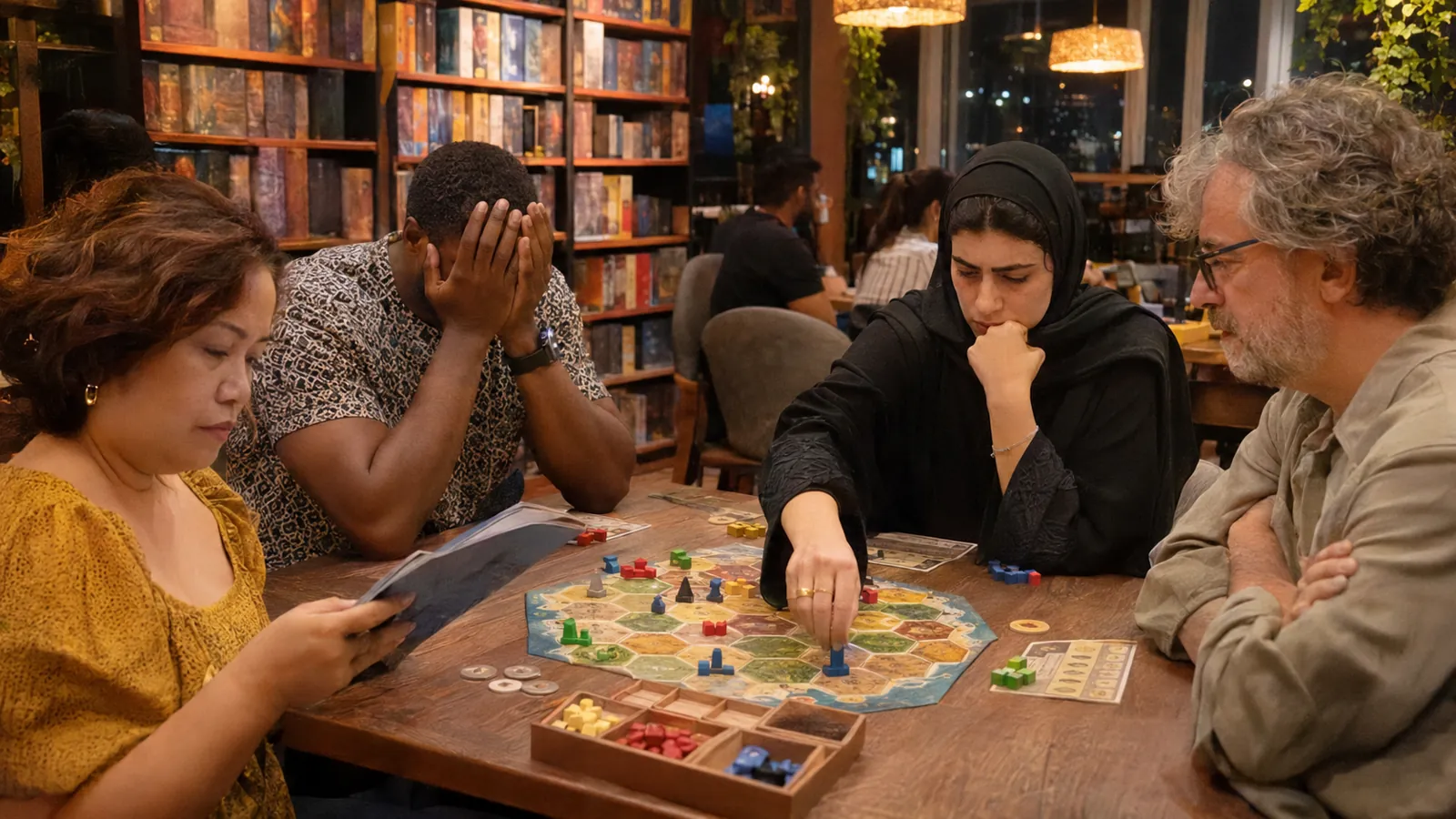 CirclesWhy a board-game night turns strangers into friends
 FriendshipMaking friends in your 30s and 40s in Dubai, when everyone seems busy
 FriendshipMaking friends in Dubai when you work long hours
 FriendshipMaking friends as an introvert in Dubai
 New in townHow to stay friends when people leave Dubai (and how to keep building your circle)
 IdeasHobbies that help you meet people in Dubai
 ResearchFrom acquaintance to friend: the follow-up habits that matter
 IdeasWalking and running spots in Dubai to explore with a friend
 IdeasThings to do with new friends in Dubai this autumn
 CirclesHow to host a small meetup that people actually come to
 FriendshipHow to start a conversation with someone new (without dreading small talk)
 IdeasWhere to meet people in Dubai when brunch and bars are not your thing
 CirclesWhy joining a circle makes friendship so much more likely
 FriendshipIs it normal to feel lonely in Dubai? What to do about it
 IdeasThings to do in Dubai, and the reason your list never happens
 NewsTruFriend is now open in Dubai: real friendships, one good introduction at a time
 FriendshipHow to make friends in Dubai as a grown-up
 New in townNew to Dubai? How to build a social life in your first months
 ResearchHow long does it take to make a friend? What the research says
 SafetyHow to meet new friends safely in Dubai