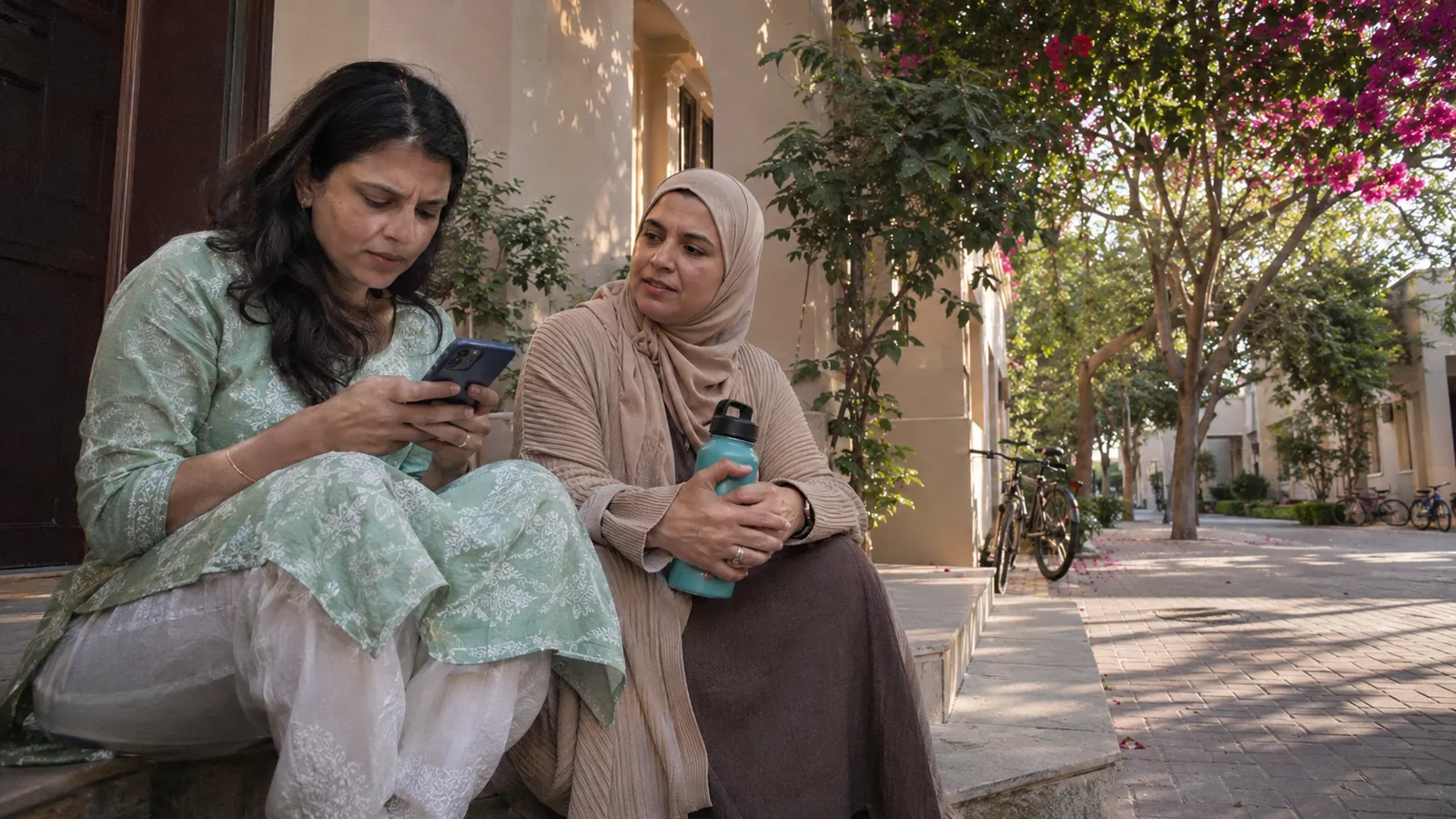
It is Wednesday evening and your phone lights up with a message from someone you met at the Saturday walk six weeks ago. You have had two coffees since. You like her. She is asking whether you fancy the book swap at a café in Al Quoz on Thursday night.
You look at your week. There is a work dinner on Tuesday, a leaving do on Wednesday, a cousin arriving on Friday, the school fair on Saturday and a desert barbecue on Sunday that you agreed to in October, when November felt a long way off. Thursday is the only evening with nothing in it. You were rather hoping to keep it that way.
So you type the reply most of us type: "Ah, sounds lovely, might be able to, will let you know!" Then you put the phone down, and you do not let her know. By Thursday afternoon it feels too late to say anything, so you say nothing. She goes to the book swap, keeps glancing at the door, and quietly files you under people who are not really interested.
The scene is illustrative, but you will recognise it from one side or the other. And the damage in it was not done by the no. It was done by everything around it.
The season when everything happens at once
Dubai does not spread its social life evenly across the year. For months the heat keeps everyone indoors and half the city is abroad. Then the weather turns, and from November to the new year it all lands at once: the outdoor season, the markets, the visiting relatives, the national holiday weekend, the office parties, the leaving dos for people who timed their exit for the end of the year.
That makes this the best time of year to build friendships and the easiest time to wreck one by accident. Everyone is overcommitted, everyone is tired, and new friends, who have no history to fall back on, are the first to be squeezed. You would never ghost your oldest friend. A person you have met three times is a different matter, and that is exactly the person you can least afford to lose this way.
Why a maybe costs more than a no
A vague maybe feels kind when you send it. It is not, really. It hands the other person a job: they now have to wait, plan around you, perhaps hold a seat or book a table for one more, and wonder whether to chase. If you then go quiet, they are left to work out for themselves what the silence meant, and people almost always fill a silence with the least flattering explanation.
A clear no, by contrast, is finished. They know where they stand, they can ask someone else, and the evening is theirs again. Most people are far more relaxed about being turned down than we imagine. What stings is being left hanging.
This matters more with new friends than old ones for a simple reason. An old friendship has years of evidence that you care, so one missed plan barely registers. A new one has almost no evidence at all. Every exchange is still being read for signal, and a pattern of maybes reads as a very clear signal, even when you did not mean one.
It also slows everything down. Jeffrey Hall at the University of Kansas estimated that it takes roughly 50 hours together to become casual friends and around 90 to become friends proper. Every plan that dissolves into a maybe is an hour that did not happen, and those hours are the whole mechanism.
The no that keeps the door open
The fix is not to say yes to everything. The fix is to say no in a way that carries its own next step.
Compare two replies to the same invitation. "Sorry, can't make it" is honest, but it closes the conversation, and the other person has to decide whether to try again. "Not Thursday, I'm completely out of evenings this week, but I'm free Sunday morning if you fancy a walk at Safa Park before it gets warm" is a no as well. It simply does not end there.
The counter-offer is the single most useful habit in this whole season. It tells the other person the no is about the calendar, not about them. It gives them something concrete to answer. And it moves the plan to a slot you can actually honour, rather than one you would have cancelled later anyway.
Two small rules make it work. First, make the counter-offer specific: a day, a rough time, a place. "Let's do something soon" is a maybe dressed up as a plan. Second, only offer what you mean. If you already know the next three weekends are full, say "early December is easier for me" and name a date then. A counter-offer you later cancel is worse than none.
When you really do have to cancel
Sometimes you said yes in good faith and life got in the way. A child with a temperature, a deadline that moved, a flight that changed. Cancelling is not a crime. The way you cancel is what people remember.
Cancel early. The difference between telling someone on Tuesday and telling them an hour before is the difference between a minor change of plan and a wasted evening. The moment you know, say so, even if part of you is still hoping it might work out.
Be specific. "Something's come up" invites the other person to imagine you found a better offer. "My daughter has a fever and I don't want to leave her tonight" does not. You do not owe anyone your private business, but a short, true reason is kinder than a vague one.
And reschedule in the same message. Not "let's rearrange", which puts the work back on them, but "could we do next Tuesday instead, same café, half past seven?" A cancellation that arrives with a new date attached barely counts as a cancellation. It is a postponement, and it proves you still want to go.
Protecting the evening you need
Here is the part people feel guilty about. Sometimes the honest reason for a no is that you have nothing on and you need it that way. After a month of dinners and early starts, an evening on the sofa is not laziness. It is how you stay decent company for the plans you do keep.
You are allowed to say so. "I've had a mad few weeks and I'm keeping Thursday free to recover, but I'd love to see you at the walk on Saturday" is a perfectly good reply, and most people will respect it more than an invented excuse. Everyone in this city is tired in December. Saying it out loud gives the other person permission to be tired too.
How to take a no gracefully
All of this runs the other way too, and you will be on the receiving end more often than you think. The person who organises things in a new friendship hears a lot of no, and it is easy to start counting.
Take it lightly. "No worries at all, another time" is the whole reply. If they offer another date, accept it or suggest one of your own. If they do not, leave it a week or two and ask again with something different. One no is information about their week. It is not a verdict on you.
What is worth noticing is a pattern. If someone says no three or four times and never once offers an alternative, they may be telling you something without having the words for it, and it is fine to let the invitations ease off. But most people who are genuinely interested will, sooner or later, counter-offer. Friendships rarely end with a falling-out. They fade when both people stop asking.
Fewer plans, better kept
Robin Dunbar's work on social networks is a useful reminder here. We only have room for a handful of close relationships, and friendships that are not fed with contact slowly slip outwards to looser rings. You cannot feed fifty of them in December. You can feed five.
So it is worth being a little ruthless in the busy season. Say no quickly and warmly to the things that do not matter, so you have the energy to turn up properly for the people who might. A regular Saturday walk, a monthly book group, one coffee a fortnight with the same person: small, repeating plans that are easy to keep will do far more for a new friendship than an invitation to everything. If you are unsure where to begin, the step from acquaintance to friend is mostly made of plans like these.
Where TruFriend fits
TruFriend was built around plans that are easy to say yes to, and easy to say no to. Tru, our assistant, learns what you enjoy, when you are actually free and how far you will travel, and introduces you to a few people nearby who fit, with the reasons you might get along. A conversation opens only when both of you say yes, so nobody is left waiting on a maybe from a stranger.
In circles, small groups around one interest such as coffee and conversation, walks and runs or books, any member can start a plan with a day, a time, a public place and a number of spaces. Others join until it is full. If Thursday does not work for you, there will be another plan on Sunday, and saying no costs nobody an evening. When you do find yourself with a free afternoon, "Free today" lets your circle know at short notice, which is the counter-offer made easy.
Friendship only, for grown-ups aged 18 and over, and free for founding members. Join TruFriend: it takes a minute.
Don’t just read about it
Join a circle of people in Dubai who enjoy the same things. Members already on TruFriend can join from the app or suggest a plan in any chat.
 Coffee & conversationA friendship circle for people who enjoy cafés and unhurried conversation in Dubai. Low-pressure first meetings, close to home.
 Walkers & runnersA friendship circle for people who like morning walks, evening runs and beach paths in Dubai. Find a regular partner at your own pace.
 Book loversA friendship circle for readers in Dubai: talk about books, swap recommendations and visit libraries and bookshops together.
Where to meet in Dubai
Public places picked for small groups of 3 to 10, sorted by interest and area.
Keep reading
 CirclesPhoto walks: seeing Dubai through a lens, with someone
 IdeasDubai Fitness Challenge: 30 days to meet people who move
 FriendshipWhen a new friendship feels one-sided
 CirclesBook clubs in Dubai: how to join one, or start one that lasts
 FriendshipMaking friends after 50 in Dubai, when the house goes quiet
 CirclesWhy padel is Dubai's friendship machine
 FriendshipFriends across cultures: when your new friend grew up somewhere else
 CirclesLearning a language to make friends: the language exchange way
 IdeasMaking friends through volunteering in Dubai
 New in townMaking friends in Dubai when you work from home
 FriendshipMaking friends as a parent in Dubai, beyond the school gate
 IdeasDubai's outdoor season: plans with friends from the desert to the mountains
 ResearchWhy friendships fade, and how to rescue one before it goes
 FriendshipMaking friends as a couple in Dubai (and keeping friends of your own)
 CirclesWhy a board-game night turns strangers into friends
 FriendshipMaking friends in your 30s and 40s in Dubai, when everyone seems busy
 FriendshipMaking friends in Dubai when you work long hours
 FriendshipMaking friends as an introvert in Dubai
 New in townHow to stay friends when people leave Dubai (and how to keep building your circle)
 IdeasHobbies that help you meet people in Dubai
 ResearchFrom acquaintance to friend: the follow-up habits that matter
 IdeasWalking and running spots in Dubai to explore with a friend
 IdeasThings to do with new friends in Dubai this autumn
 CirclesHow to host a small meetup that people actually come to
 FriendshipHow to start a conversation with someone new (without dreading small talk)
 IdeasWhere to meet people in Dubai when brunch and bars are not your thing
 CirclesWhy joining a circle makes friendship so much more likely
 FriendshipIs it normal to feel lonely in Dubai? What to do about it
 IdeasThings to do in Dubai, and the reason your list never happens
 NewsTruFriend is now open in Dubai: real friendships, one good introduction at a time
 FriendshipHow to make friends in Dubai as a grown-up
 New in townNew to Dubai? How to build a social life in your first months
 ResearchHow long does it take to make a friend? What the research says
 SafetyHow to meet new friends safely in Dubai