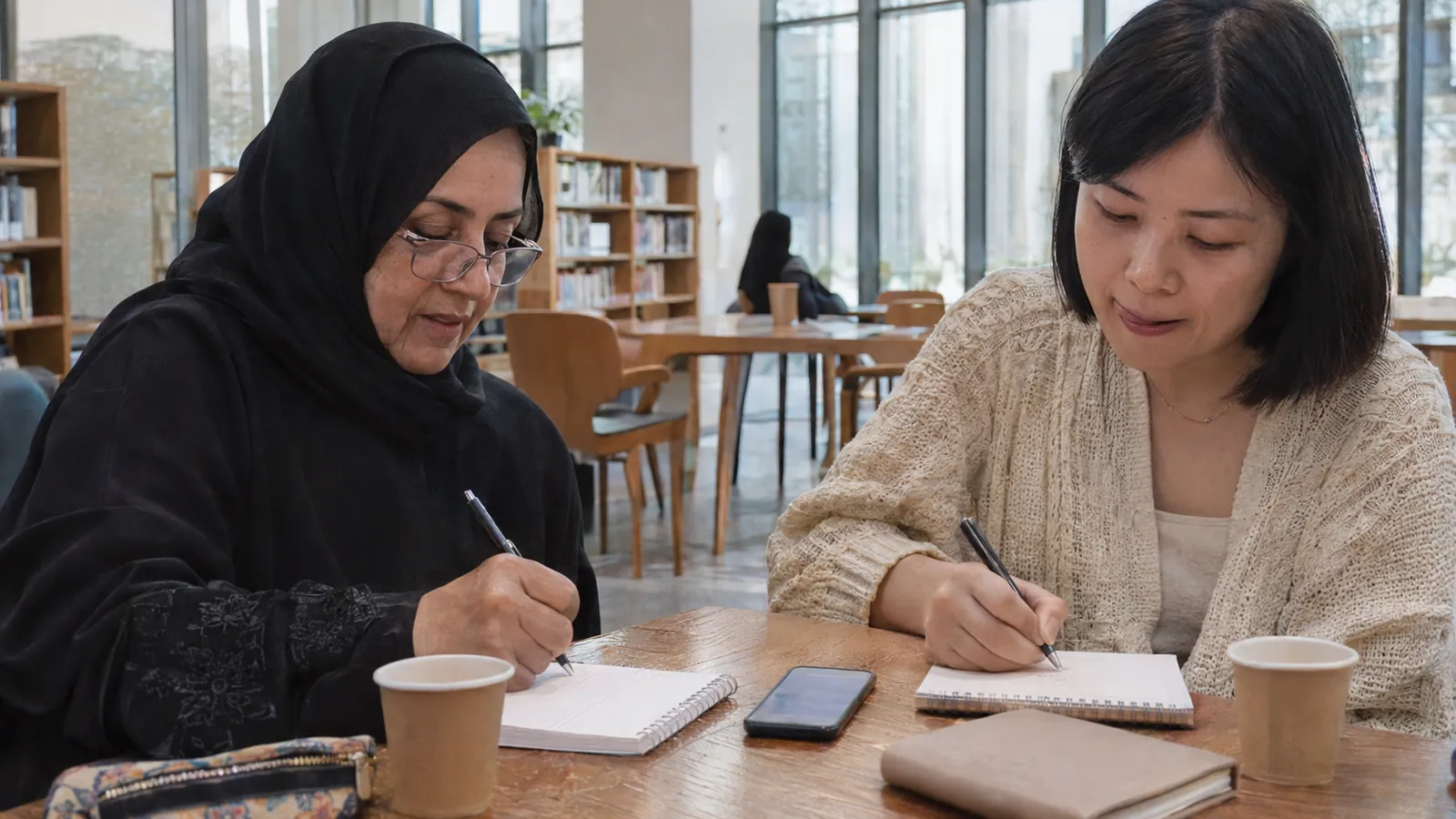
You are at a small table in a café in Al Karama on a Saturday morning, trying to order two teas in Arabic. You have practised the sentence in the car. It comes out in the wrong order, with one word from French and the verb missing entirely. The person opposite you, who you met twenty minutes ago, puts a hand over her mouth, fails to hide that she is laughing, and then says it back to you slowly, properly, twice. You try again. It is better. The waiter, who has watched all of this, gives you a thumbs up.
Half an hour later the roles swap. She is trying to explain in English why her cousin's wedding went on for three days, and she gets stuck on a word, and now it is your turn to be patient. By the time you leave you have spoken more honestly with a stranger than you have with most of your colleagues this year, and you have agreed, without really deciding to, to do the same thing next Saturday.
That is a language exchange. It is one of the oldest ways of making a friend in a city full of people from somewhere else, and Dubai is unusually good for it.
A city that talks in dozens of languages
Walk through almost any part of Dubai and count the languages you overhear. Arabic, in several quite different accents. Hindi and Urdu, which sound close enough that their speakers can often follow each other. Malayalam, Tamil, Bengali, Tagalog, Persian, Russian, French, and English holding the whole thing together as the language of shops, offices and street signs.
English being everywhere is convenient, and it is also a quiet trap. You can live here for years without needing another word, and plenty of people do. The result is that most of us move through the city in a thin layer of shared English, polite and a little flat, while everyone around us has a whole other life in another language that we never see.
A language exchange cracks that layer open. It turns the city's mix of languages from background noise into something you can trade. Nearly everyone you meet here speaks something you do not, and would like to be better at something you do.
Why swapping works better than a class
The format is simple. Two people, each wanting to learn the other's language. You meet for an hour. The first half-hour is in one language, the second in the other. Then you do it again next week.
What makes it so good for friendship is not the learning. It is the shape of the arrangement. Rebecca Adams, a sociologist who has studied friendship for decades, describes three conditions that friendships tend to grow from: being near each other, seeing each other repeatedly without having to plan it every time, and a setting where people feel safe enough to share something. A language exchange builds all three into the deal.
The meeting that repeats itself
The repetition is written in from the start. Nobody has to find an excuse to meet again, because meeting again is the whole point. You cannot learn a language in one coffee. Both of you know that on day one, so the question "shall we do this again?" never has to be asked. That alone removes the step where most budding friendships in this city quietly die.
And the setting forces sharing. Language practice needs something to talk about, so you end up describing your family, your job, your hometown, what you ate last night, what you are worried about. It is very hard to be guarded in a language where you only know the present tense.
Being bad at something together
Most first meetings are a small performance. We tell our best stories, choose our words, try to seem interesting. A language exchange makes that impossible, and it turns out to be a relief.
For half of every hour, you are the one who sounds like a child. You mispronounce things. You say something rude by accident and have it explained to you. Then the table turns and the other person is the one fumbling. Neither of you can pretend to be more polished than you are, and because you are both exposed in turn, it feels fair. Nobody is being judged by someone who is not also being judged.
That shared embarrassment lets you laugh at yourself in front of someone, and be laughed with rather than at. Once that has happened a few times, the relationship has a different texture. You have seen each other at a slight disadvantage and found it fine. That is usually a step further than weeks of small talk would have taken you.
Learning Arabic to belong to the city
If you are going to pick one language to swap for in Dubai, there is a strong case for Arabic. Not because you will need it for daily errands, since you mostly will not, but because of what it does to your sense of the place.
A few words of greeting, used properly, change small moments. The security guard who hears you say good morning in Arabic. The older man at the next table who corrects your pronunciation with obvious pleasure. The colleague who starts teaching you the local version of a phrase rather than the textbook one. Emirati Arabic, and the Levantine and Egyptian Arabic you will also hear a lot of here, differ quite a bit from the Modern Standard Arabic taught in most courses. An exchange partner can give you the everyday version, and tell you which words sound old-fashioned or oddly formal when you use them.
It also works in reverse. Plenty of Arabic speakers in Dubai want to polish their English, or pick up French or another language for work, and are glad of a patient partner. The trade is genuine on both sides, which matters. Friendships built on a fair swap tend to last better than ones where one person is always doing the favour.
A practical format that keeps going
Most exchanges that fizzle out do so for boring, fixable reasons. A few habits keep them alive.
Pick a fixed slot and a fixed place. Same day, same time, same café, ideally somewhere halfway between you. A public café keeps a first meeting comfortable for both people. The usual common sense for meeting someone new applies here as it does anywhere.
Keep the halves honest. Use a timer on your phone if you need to. The person whose language is stronger will drift into it without meaning to, and after a few weeks one of you will feel short-changed without quite saying so. Thirty minutes each, strictly, avoids that.
Bring a topic, not a textbook. A photo from your weekend, a menu, a news story, a recipe your mother makes. Real things give you real vocabulary and, more importantly, something to talk about that is actually about your lives.
Correct gently, and ask to be corrected. Agree early on how much correction you each want. Some people like every mistake flagged; others want to keep talking and hear the three most useful fixes at the end.
From exchange partner to friend
Jeffrey Hall at the University of Kansas estimated that it takes roughly 50 hours together to move from acquaintance to casual friend, around 90 to become a friend, and more than 200 to become close. Those numbers sound daunting until you look at what a weekly exchange quietly does. An hour a week, every week, from November to the summer, puts you somewhere around 30 hours before either of you has even noticed.
The shift usually happens in small ways. The exchange runs over because you are both in the middle of a story. One week you skip the second language entirely because something happened and you just need to talk. Then someone suggests trying their favourite shawarma place instead of the café, or a walk along the Creek to practise the words for everything you pass. The lesson becomes an excuse, and then it stops being needed at all.
You may never become fluent. Most people do not. But the friend is the part that tends to stay, long after you have forgotten the difference between the two words for "to know".
Where TruFriend fits
The language exchange circle is where this starts on TruFriend. It is a small group of people who want to swap languages, with a quick question every week to get people talking. Any member can start a plan, choosing the day, the time, a public place and the number of spaces, and others in the circle join until it is full. A Saturday morning practice table at a café is exactly the kind of plan it was made for.
Tru, our assistant, learns what you enjoy, when you are free and how far you will travel, and introduces a few people nearby who fit, with reasons, so you can find someone who speaks what you want to learn and wants what you speak. A conversation opens only when both of you say yes, and every member's photo is checked, so the person across the table is a real one. If you are new in Dubai, the new-in-Dubai and coffee-and-conversation circles are good companions to this one.
Friendship only, for grown-ups aged 18 and over, and free for founding members. Join TruFriend: it takes a minute.
Don’t just read about it
Join a circle of people in Dubai who enjoy the same things. Members already on TruFriend can join from the app or suggest a plan in any chat.
 Language exchangeA friendship circle for language exchange in Dubai: practise Arabic, English or another language over coffee, and help someone with yours.
 Coffee & conversationA friendship circle for people who enjoy cafés and unhurried conversation in Dubai. Low-pressure first meetings, close to home.
 New in DubaiA friendship circle for people who have recently moved to Dubai: settle in, explore the city and build a social life with others doing the same.
Where to meet in Dubai
Public places picked for small groups of 3 to 10, sorted by interest and area.
Keep reading
 FriendshipHow to say no to a plan without losing the friend
 CirclesPhoto walks: seeing Dubai through a lens, with someone
 IdeasDubai Fitness Challenge: 30 days to meet people who move
 FriendshipWhen a new friendship feels one-sided
 CirclesBook clubs in Dubai: how to join one, or start one that lasts
 FriendshipMaking friends after 50 in Dubai, when the house goes quiet
 CirclesWhy padel is Dubai's friendship machine
 FriendshipFriends across cultures: when your new friend grew up somewhere else
 IdeasMaking friends through volunteering in Dubai
 New in townMaking friends in Dubai when you work from home
 FriendshipMaking friends as a parent in Dubai, beyond the school gate
 IdeasDubai's outdoor season: plans with friends from the desert to the mountains
 ResearchWhy friendships fade, and how to rescue one before it goes
 FriendshipMaking friends as a couple in Dubai (and keeping friends of your own)
 CirclesWhy a board-game night turns strangers into friends
 FriendshipMaking friends in your 30s and 40s in Dubai, when everyone seems busy
 FriendshipMaking friends in Dubai when you work long hours
 FriendshipMaking friends as an introvert in Dubai
 New in townHow to stay friends when people leave Dubai (and how to keep building your circle)
 IdeasHobbies that help you meet people in Dubai
 ResearchFrom acquaintance to friend: the follow-up habits that matter
 IdeasWalking and running spots in Dubai to explore with a friend
 IdeasThings to do with new friends in Dubai this autumn
 CirclesHow to host a small meetup that people actually come to
 FriendshipHow to start a conversation with someone new (without dreading small talk)
 IdeasWhere to meet people in Dubai when brunch and bars are not your thing
 CirclesWhy joining a circle makes friendship so much more likely
 FriendshipIs it normal to feel lonely in Dubai? What to do about it
 IdeasThings to do in Dubai, and the reason your list never happens
 NewsTruFriend is now open in Dubai: real friendships, one good introduction at a time
 FriendshipHow to make friends in Dubai as a grown-up
 New in townNew to Dubai? How to build a social life in your first months
 ResearchHow long does it take to make a friend? What the research says
 SafetyHow to meet new friends safely in Dubai