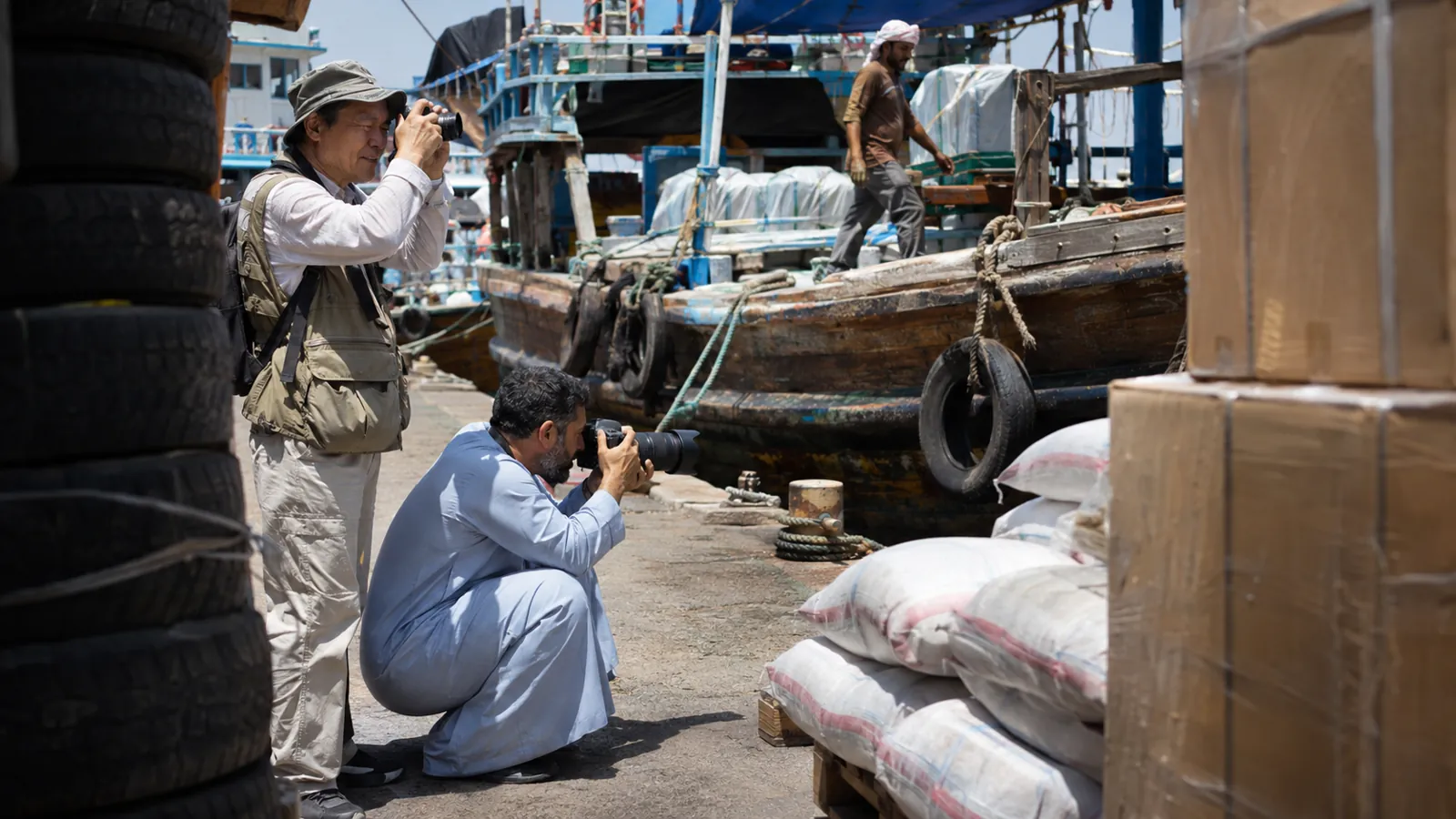
It is a Saturday morning in the lanes of Al Fahidi, a little after eight. The light is still low and gold, the wind towers are throwing long shadows across the sand-coloured walls, and you are crouched in a doorway trying to get a carved wooden door and a bougainvillea into the same frame. A few metres away, someone else is doing exactly the same thing with a different door. You have met this person once before, twenty minutes ago, at the coffee cart by the car park.
Neither of you has said much. You have not needed to. Every few minutes one of you turns the screen round and says "look at this", and the other one looks, and that is the conversation. By the time you reach the Creek, it has become an actual conversation, about where each of you grew up and why you both own a camera you barely use. Nobody planned that part. The walk did it.
Side by side is easier than face to face
There is a reason so many first meetings feel stiff. Two strangers across a café table have nothing to look at except each other, and every pause feels like a small test. A walk changes the geometry. You are next to someone rather than opposite them, facing the same way, and silence stops being awkward because there is always something to look at.
A camera goes one step further. It gives both of you a job. You are not there to be interesting, you are there to find a good shadow, and the talking happens around the edges of that. For anyone who dreads small talk, or who recharges alone and finds new people tiring, this is a gift. You can be quiet for ten minutes without anyone wondering what went wrong.
It does not have to be a proper camera, either. Most people on a photo walk now carry a phone and nothing else, and the phones are more than good enough. The kit is not the point. The shared attention is.
What it does to the way you see the city
Most of us move through Dubai in a car, from one air-conditioned door to another, looking at a screen at the traffic lights. A photo walk forces you to slow down to about two kilometres an hour and actually look. You notice the painted numbers on a Deira shopfront, the way the late light turns the Creek the colour of tea, the man asleep on a stack of rice sacks by the dhow wharf.
Slowing down with another person is quietly intimate in a way that is hard to describe until you have done it. You start to learn what they notice. One person keeps photographing hands and faces; another only ever shoots lines, windows and stairwells. You learn something about how someone's mind works from what they stop for, long before you would learn it from what they say about themselves.
Old Dubai: Al Fahidi, the Creek and Deira
Dubai is better for this than its reputation suggests, as long as you leave the malls behind.
Al Fahidi Historical Neighbourhood, still called Bastakiya by many, is the obvious start and deserves it. Narrow lanes, restored courtyard houses, wind towers, small galleries and cafés tucked into old buildings. It is compact enough to wander without a plan and quiet in the early morning.
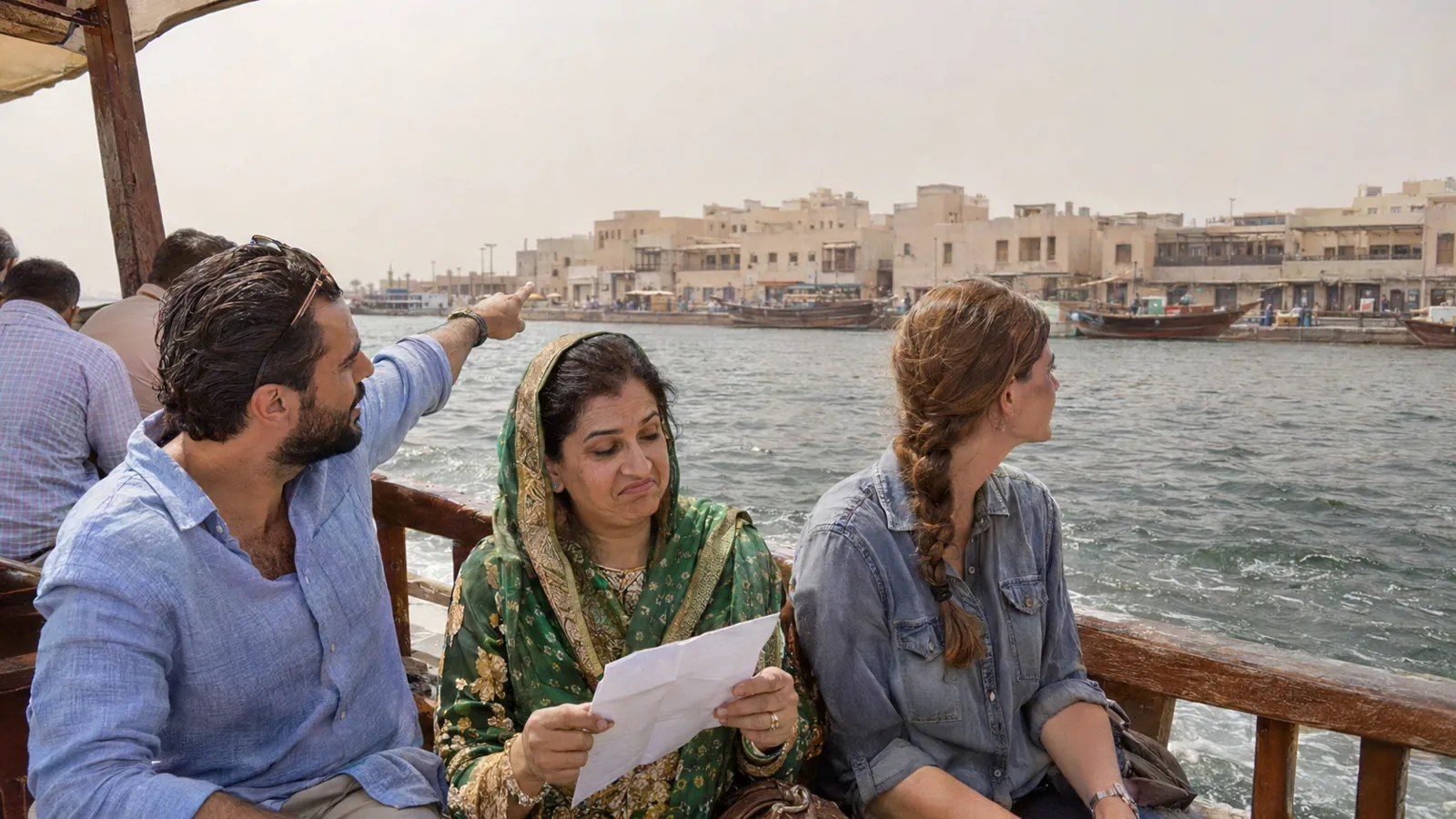
From there it is a short walk to the Creek. The traditional abras carry people across to Deira for about a dirham, and the crossing itself is one of the best five minutes of photography in the city: the boatman, the water, the skyline changing as you move. On the Deira side, the Spice Souk and Gold Souk are dense with colour and texture, and the older streets around them are full of life, especially in the late afternoon.
The newer city: Alserkal, the Marina and the beach
For something completely different, Alserkal Avenue in Al Quoz is a cluster of converted warehouses holding galleries, studios and cafés. The architecture is all concrete, shadow and hard angles, and you can duck inside to look at someone else's work when you run out of ideas of your own.
Dubai Marina at blue hour, the short spell just after sunset when the sky turns deep blue and the towers light up, is the classic city shot for good reason. The promenade is long and flat, and the reflections in the water do half the work for you.
And for mornings, JBR and Kite Beach have soft early light, runners, kites, dog walkers and the Burj Al Arab in the distance. If you already walk or run on the beach, bring a phone one week and go at half the speed.
The etiquette that matters most
This part is not optional, so it is worth saying plainly. In the UAE, photographing people without their consent is taken seriously, and sharing those photos online without permission can break the law. Privacy is protected more strictly here than in many of the countries people move from, and "everyone does it at home" is not a defence.
The practical rule is simple: always ask before you photograph a person, and take no for an answer without fuss. Be especially careful with women and with families, and never photograph children who are not yours. A smile and a gesture at your camera is usually enough to ask; plenty of stallholders and abra drivers will say yes, and some will pose. If someone waves you off, lower the camera and move on.
Respect signs, too. Some buildings, private property and government or security sites do not allow photography, and hotels and malls have their own rules. If there is a sign, follow it. If a guard asks you to stop, stop. When you share photos afterwards, crop or leave out anyone who did not agree to be in them. None of this spoils the fun. It just means the fun belongs to everyone in the picture.
If you are meeting someone new for a walk, the usual common sense applies as well: a public, busy place, daylight or early evening, and a friend who knows where you are. Our page on meeting new friends safely covers the rest.
Why it repeats so well
The research on friendship keeps pointing to the same few ingredients. Rebecca Adams, a sociologist, describes three conditions: being near each other, seeing each other repeatedly without having to arrange it each time, and a setting relaxed enough to open up a little. Jeffrey Hall at the University of Kansas estimated that it takes something like 50 hours together to become casual friends and around 90 to become friends. You do not get there in one outing.
Photo walks are built to repeat. There is always another neighbourhood, another season, another kind of light. The same small group can do a different walk every fortnight for a year without running out, and each walk is a couple of hours side by side. That adds up faster than you would think, and it adds up without anyone having to invent a reason to meet.
Swapping photos: the follow-up that does itself
The hardest part of any new friendship is the message afterwards. You had a nice time, you both said "let's do it again", and then neither of you writes because it feels a bit much.
A photo walk hands you the follow-up. That evening, you send the three shots you took of the other person's favourite door, or the one of them laughing on the abra, which they agreed to on the day and can now veto properly. They send back their best frame of the souk. Nobody has to think of something clever to say. The photos are the message, and they come with a built-in reply: "that's so much better than mine, where were you standing?"
From there the next walk is easy to suggest. "Alserkal next Saturday? I want to try the warehouses in black and white." It is specific, it is small, and it gives the other person a reason to say yes. That kind of concrete next plan is usually what turns a pleasant morning into a friendship.
Where TruFriend fits
TruFriend has a photo walks circle for exactly this, alongside circles for art and culture and walks and runs. Circles are small groups around one interest, with a quick question every week to get people talking. Any member can start a plan, with a day, a time, a public meeting point and a number of spaces, and others in the circle join until it is full. If you wake up on a clear Friday with an empty morning, "Free today" tells your circle you are around at short notice.
Tru, our assistant, learns what you enjoy, when you are free and how far you will travel, then introduces a few people nearby who fit, with the reasons you might get along. A conversation opens only when both of you say yes, and every member's photo is checked, so the person holding the other camera is a real person. Tru Thursday, a short weekly email, keeps you in the loop.
Friendship only, for grown-ups aged 18 and over, and free for founding members. Join TruFriend: it takes a minute.
Don’t just read about it
Join a circle of people in Dubai who enjoy the same things. Members already on TruFriend can join from the app or suggest a plan in any chat.
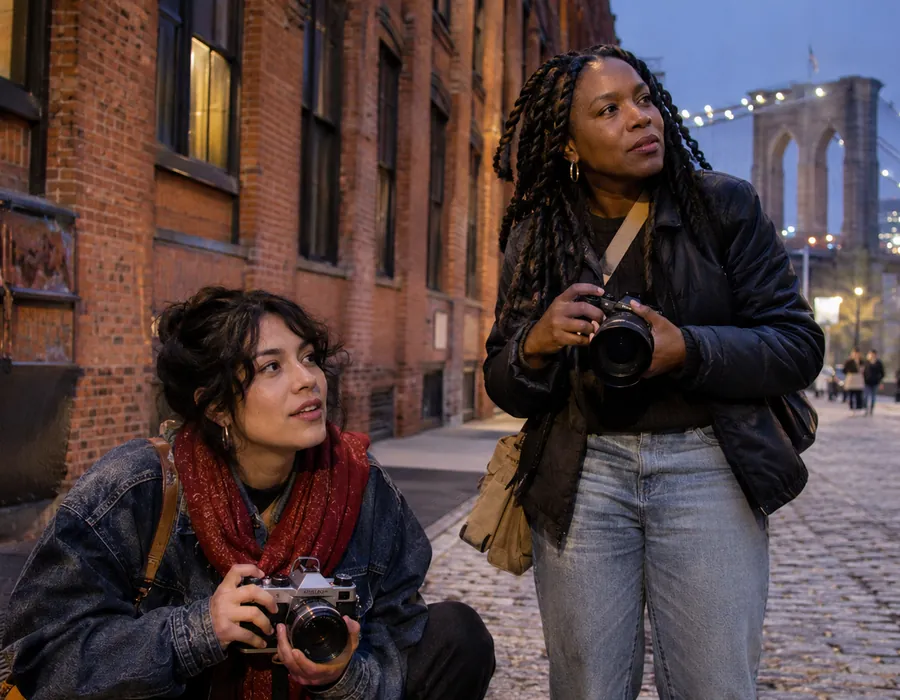 Photo walksA friendship circle for photographers of every level: explore Dubai’s streets, skyline and old neighbourhoods together.
 Art & cultureA friendship circle for galleries, museums, theatre and live music in Dubai. Find people to see shows and exhibitions with.
 Walkers & runnersA friendship circle for people who like morning walks, evening runs and beach paths in Dubai. Find a regular partner at your own pace.
Where to meet in Dubai
Public places picked for small groups of 3 to 10, sorted by interest and area.
Keep reading
 FriendshipHow to say no to a plan without losing the friend
 IdeasDubai Fitness Challenge: 30 days to meet people who move
 FriendshipWhen a new friendship feels one-sided
 CirclesBook clubs in Dubai: how to join one, or start one that lasts
 FriendshipMaking friends after 50 in Dubai, when the house goes quiet
 CirclesWhy padel is Dubai's friendship machine
 FriendshipFriends across cultures: when your new friend grew up somewhere else
 CirclesLearning a language to make friends: the language exchange way
 IdeasMaking friends through volunteering in Dubai
 New in townMaking friends in Dubai when you work from home
 FriendshipMaking friends as a parent in Dubai, beyond the school gate
 IdeasDubai's outdoor season: plans with friends from the desert to the mountains
 ResearchWhy friendships fade, and how to rescue one before it goes
 FriendshipMaking friends as a couple in Dubai (and keeping friends of your own)
 CirclesWhy a board-game night turns strangers into friends
 FriendshipMaking friends in your 30s and 40s in Dubai, when everyone seems busy
 FriendshipMaking friends in Dubai when you work long hours
 FriendshipMaking friends as an introvert in Dubai
 New in townHow to stay friends when people leave Dubai (and how to keep building your circle)
 IdeasHobbies that help you meet people in Dubai
 ResearchFrom acquaintance to friend: the follow-up habits that matter
 IdeasWalking and running spots in Dubai to explore with a friend
 IdeasThings to do with new friends in Dubai this autumn
 CirclesHow to host a small meetup that people actually come to
 FriendshipHow to start a conversation with someone new (without dreading small talk)
 IdeasWhere to meet people in Dubai when brunch and bars are not your thing
 CirclesWhy joining a circle makes friendship so much more likely
 FriendshipIs it normal to feel lonely in Dubai? What to do about it
 IdeasThings to do in Dubai, and the reason your list never happens
 NewsTruFriend is now open in Dubai: real friendships, one good introduction at a time
 FriendshipHow to make friends in Dubai as a grown-up
 New in townNew to Dubai? How to build a social life in your first months
 ResearchHow long does it take to make a friend? What the research says
 SafetyHow to meet new friends safely in Dubai