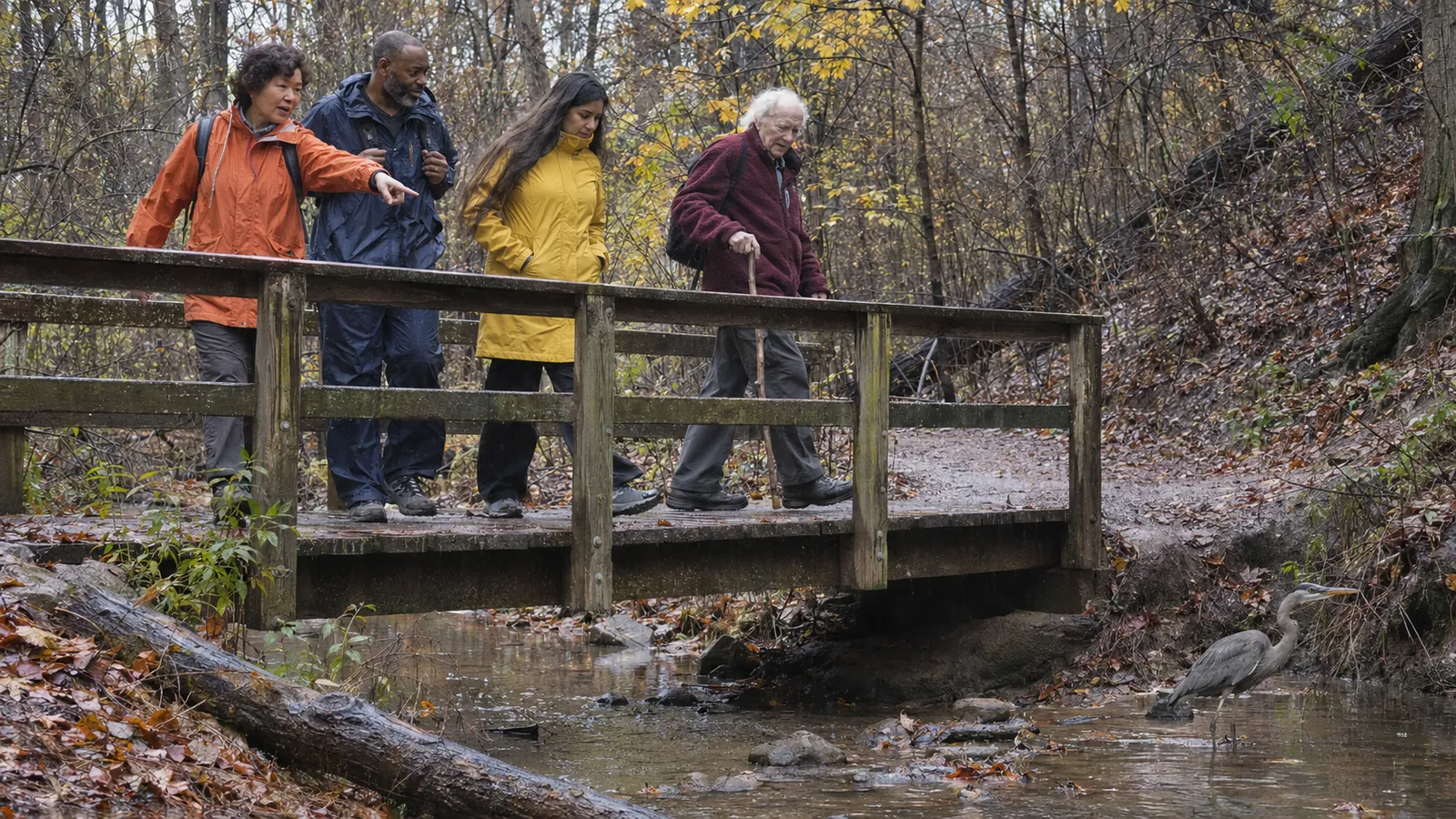
Most people who move to Toronto discover the ravines by accident. You are walking to a subway station, you take a wrong turn behind a row of houses, and the street simply falls away. A staircase drops into a valley full of trees, a creek runs along the bottom, and within two minutes the traffic noise is gone. It feels like a secret, and in a way it is: Toronto has one of the largest networks of urban ravines in the world, threaded through the city like green veins, and many people live here for years without walking more than a few hundred metres of it.
This post is not a guide to every trail. It is about something more useful: why a walk in a ravine is one of the best ways to turn a stranger into a friend in this city, and how to make it a habit rather than a one-time outing.
Why walking works when talking does not
Ask most grown-ups what makes a first meeting with someone new uncomfortable, and they will describe the same scene: two people facing each other across a small café table, both aware of the silences, both trying to think of the next question. Face-to-face conversation with a near-stranger is surprisingly hard work.
Walking changes the geometry. You are side by side instead of opposite each other. You both look ahead, at the path, at the trees, at a heron standing in the creek. Silences stop being awkward because there is always something to notice. People who barely say a word over coffee will talk for an hour on a trail, often about things they would never raise at a table. Psychologists have a name for this, but you do not need the theory to feel it. Anyone who has had a long conversation in a car knows the effect.
There is a second reason walking suits friendship: it repeats well. A good walk is not a performance or an event you have to top next time. The same loop can be walked every Saturday for a year and stay pleasant, because the ravine changes with the seasons even when the route does not. That repetition, the same people on the same path week after week, is exactly what turns acquaintances into friends.
Lena and the Saturday loop
Lena moved to Toronto from Lisbon for a job at a hospital downtown. Her shifts were long and irregular, and the people she met at work were kind but exhausted, going home to families as soon as their shifts ended. After six months she could name the barista at her local coffee shop and nobody else outside the hospital.
She joined a walking circle mostly because walking was the only activity her schedule could reliably hold. The first plan she joined was a Saturday morning loop in the Don Valley, starting near Evergreen Brick Works, the old brick factory that is now a community space with a weekend market. Five people turned up. Two of them never came back. Three did, along with Lena, and over the following weeks the loop became a fixed point in all four of their lives.
Nothing dramatic happened. They walked, they talked, they stopped for coffee at the market afterwards. Somewhere around the second month, one of them, a retired teacher named Graham, mentioned he was helping his daughter move flats and could use an extra pair of hands. Lena and the others turned up. A few weeks later, when Lena's parents visited from Portugal, the group took them on the same loop. By the time the first snow came, she had a group chat she actually looked forward to and three people who would notice if she went quiet.
That is what friendship usually looks like when it forms well: not a single great conversation, but a pattern that slowly fills with small favours and shared jokes.
The ravines worth getting to know
You do not need to know every trail to start. A few well-known areas make good regular routes for a small group:
The Don Valley runs through the middle of the city, and the area around Evergreen Brick Works makes a natural meeting point, with trails, ponds and somewhere to warm up afterwards. The Humber River valley on the west side offers long, gentle paths along the water that suit a slower pace and longer conversations. Glen Stewart Ravine near the Beaches is short and steep-sided, with a boardwalk under tall trees, and pairs well with a walk along the lake afterwards. Further east, Rouge National Urban Park, Canada's first national urban park, is the place for a longer half-day outing when the group is ready for one.
For a lakeside alternative, the Martin Goodman Trail follows the waterfront for kilometres and is busy with walkers, runners and cyclists in every season. It is less of a hidden world than the ravines, but it is easy to reach and easy to agree on.
Our Toronto places for walkers and runners and outdoor places list meeting points that work well for small groups.
How to make a walk become a friendship
Keep the route the same, at least at first. Novelty is fun, but familiarity is what lets people relax. A fixed loop at a fixed time means nobody has to plan anything, and people can simply turn up. Once the group has settled, you can add a monthly "new route" walk for variety.
Choose a time people can actually keep. Saturday or Sunday mornings work for most people because they do not collide with work. An early weekday evening walk can work in late spring and summer, when the light lasts, but becomes hard to sustain once it is dark by five.
End somewhere warm. The walk is where the talking starts; the coffee afterwards is where plans get made. A café near the trailhead turns a one-hour walk into a morning and gives people a natural moment to swap numbers or suggest something else.
Do not let the group grow too big. Four to six people is ideal. Beyond eight, a walk splits into separate conversations and newcomers drift to the back. Small groups mean everyone gets to know everyone.
Take winter seriously, but do not stop. Toronto winters are real, and some ravine trails become icy. Good boots, a shorter route and a hot drink afterwards keep the habit alive. The groups that keep walking through January are the ones that become close; shared discomfort is surprisingly bonding.
Safety, simply
Ravines are public parkland, but some sections are quiet. Meet in a busy, well-known spot, walk in daylight, stay on main trails, and tell someone where you are going. For a first walk with people you have just met, choose a popular route rather than a remote one. TruFriend plans always meet in public places, and that applies to trails too.
Starting your own loop
If there is no walking group near you, start one. It takes less than you think: pick a meeting point, a time and a loop of about an hour, and invite people in the Walkers & runners circle or the Hiking & outdoors circle. You do not need to be an expert on the trail or a natural host. You only need to show up at the same place at the same time and let the path do most of the work.
If you are new to the city and still finding your feet, our guide to your first month in Toronto has more ideas for building a routine, and where to meet people in Toronto in winter covers the colder months.
Lena still walks the Don Valley loop most Saturdays. The group has changed a little over time, as groups do, but the core has stayed. When people ask how she made friends in Toronto, she gives an answer that sounds too simple to be true: "I kept going to the same walk." It is simple, and it is true. If you would like to find people to walk with, join TruFriend; it takes a minute.
Don’t just read about it
Join a circle of people in Toronto who enjoy the same things. Members already on TruFriend can join from the app or suggest a plan in any chat.
 Walkers & runnersA friendship circle for people who want company on a walk or an easy run in Toronto, at a pace that suits everyone.
 Hiking & outdoorsA friendship circle for people who want to get outdoors around Toronto: the ravines, the lakeshore and the trails beyond the city.
 New in TorontoA friendship circle for grown-ups (18+) who have recently moved to Toronto: settle in, learn the city and build a social life with others doing the same.
Where to meet in Toronto
Public places picked for small groups of 3 to 10, sorted by interest and area.
Keep reading
 CirclesLanguage exchange in Toronto: learn a language, find friends
 FriendshipPet lovers in Toronto: how dogs (and cats) bring people together
 IdeasToronto's galleries and museums are better with friends
 CirclesBook lovers in Toronto: how the library became a place to make friends
 FriendshipNew in Toronto: what to do in your first month so the city stops feeling like a hotel
 IdeasEating together in Toronto: how a shared table builds friendships faster than anything else
 IdeasWhere to meet people in Toronto in winter, when nobody wants to stand outside
 FriendshipHow to make friends in Toronto as a grown-up
 NewsTruFriend is now open in Toronto