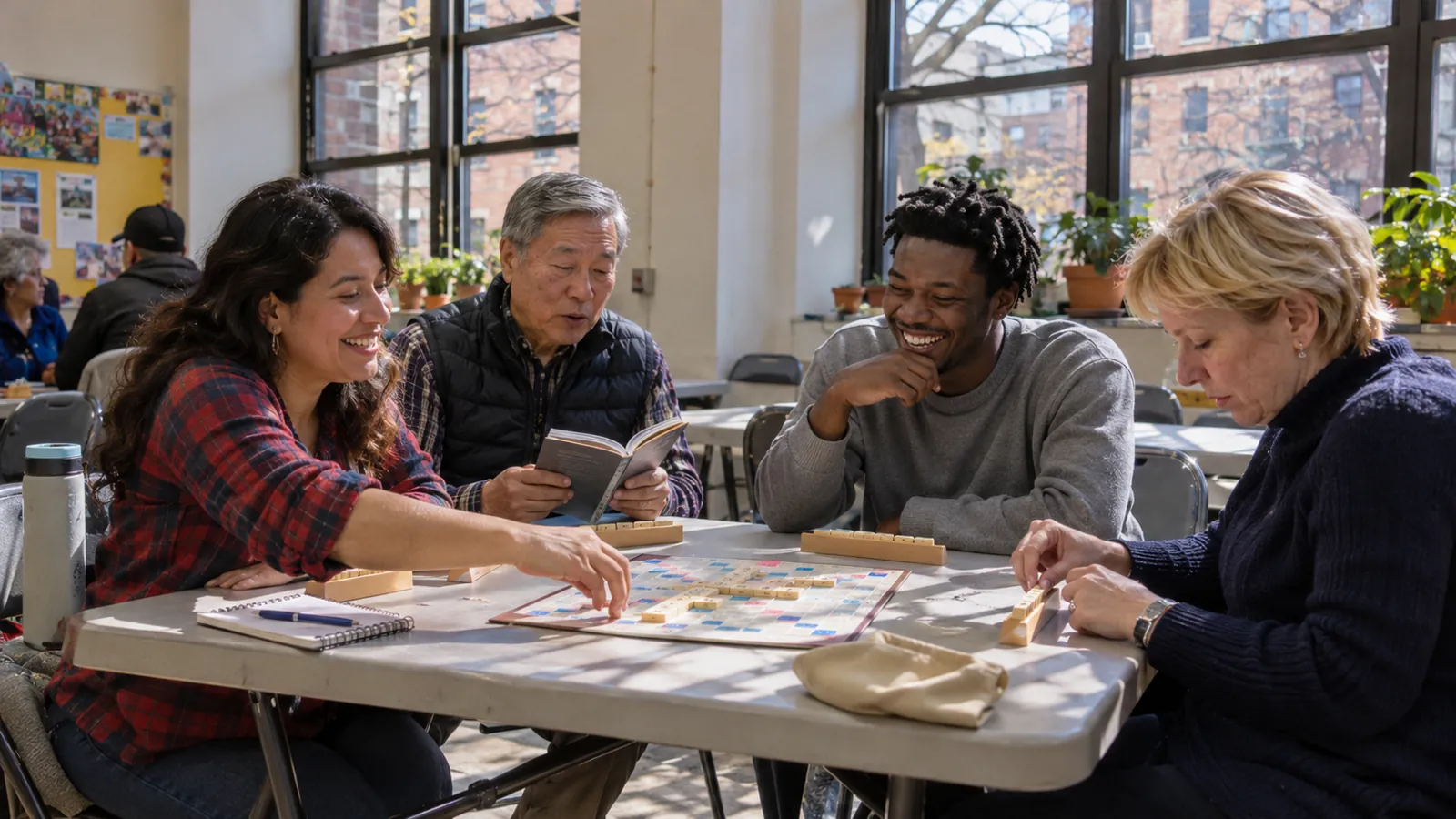
Sophia moved to New York from Lisbon for a master’s degree, and for the first few months her English felt like a coat that did not quite fit. She could follow her lectures, write her essays and order a coffee, but the quick, jokey conversations of her classmates went past her like express trains. By November she had stopped going to anything social at all. It was easier to stay in her small room in Jackson Heights and call home.
One Saturday a librarian at the Queens Public Library suggested she try an English conversation group that met there every week. She almost did not go. When she arrived, there were eight people around a table: a nurse from Colombia, a taxi driver from Bangladesh, a grandmother from Korea, a young engineer from Egypt and a retired schoolteacher from the Bronx called Daniel, who volunteered to help run the group. They talked about food, the subway and the weather, and nobody minded when Sophia searched for a word. Afterwards, three of them went to a café round the corner and kept talking for another hour. The following week, Daniel brought a deck of cards and taught them a game his grandmother used to play. That was the start of a group that now meets every Saturday afternoon, half to practise languages and half to play.
Why games and languages make friendship easier
The hardest part of meeting new people is often knowing what to say. Board games and language exchange solve that problem in the same way: they give everyone something to do together. In a game, the conversation comes from the board. Whose turn is it? Was that move fair? Who on earth thought that would work? In a language exchange, the conversation is the activity itself, and every mistake becomes a small shared joke.
Both also take the pressure off. You are not trying to impress anyone. You are trying to roll a six or remember the Spanish word for umbrella. People relax, laugh at themselves and show sides of their personality that rarely come out in a polite first chat. Daniel says you learn more about someone in one game of cards than in a month of saying hello in the lift. You find out who is competitive, who is generous, who cheats a little and laughs about it, and who quietly helps the newcomer understand the rules.
Libraries: New York’s great free meeting places
New York is lucky to have three public library systems, and they are some of the best places in the city to meet people. The New York Public Library, which covers Manhattan, the Bronx and Staten Island, runs free English conversation groups at branches across the city, along with book clubs, chess clubs and classes. Its main building on Fifth Avenue, the Stephen A. Schwarzman Building with its famous stone lions, is a wonderful landmark for a group’s first meeting.
The Brooklyn Public Library, with its grand Central Library at Grand Army Plaza beside Prospect Park, hosts language groups, game afternoons and talks. The Queens Public Library serves what may be the most linguistically varied place on earth, where hundreds of languages are spoken, and its branches in Flushing, Jackson Heights and Jamaica are full of people practising English and sharing their own languages in return. All of these are free, public, warm in winter and staffed by people who are glad to see you.
For newcomers, libraries have another advantage. They feel welcoming to everyone, whatever their age, background or level of English. Nobody has to buy anything, and nobody asks why you are there.
Games in the park
When the weather is good, New York takes its games outside. Bryant Park, behind the main library in Midtown, sets out tables for board games, chess and table tennis in the warmer months, and it is one of the most relaxed places in Manhattan to spend a Saturday afternoon. In Washington Square Park, in Lower Manhattan, the chess tables in the south-west corner have drawn players of every age and background for decades. Anyone can watch, and many regulars are happy to play a newcomer.
Sophia’s group meets in Bryant Park through the summer. They bring a bag of games, find a couple of tables and spend the afternoon switching between English, Portuguese, Spanish and Bengali. Passers-by often stop to watch, and more than one has ended up joining. In winter they move back indoors to the library or a busy café, where a big table and a pot of tea make the perfect setting for a long game.
How a good exchange works
Language exchange works best when everyone gives and takes. A simple rule helps: half the time in one language, half in another. Sophia helps a Colombian nurse called Valeria with Portuguese, and Valeria helps her with the kind of English idioms that never appear in textbooks. Daniel, who has spoken only English all his life, is slowly learning Spanish from the whole group and has become famous for his enthusiastic but very approximate accent.
The group has a few habits that keep things friendly. They keep it small, between four and eight people, so everyone gets a chance to speak. They correct each other gently and only when asked. They choose simple games that do not need perfect language skills, such as card games, word games played slowly, and classic board games with clear rules. And they always leave time at the end simply to talk, in whatever language comes out.
For anyone nervous about a first visit, Daniel has simple advice. Arrive a few minutes early, say hello to whoever is already there and offer to learn the rules rather than pretending you know them. Being the beginner is the fastest way into any game, because everyone enjoys teaching. And if your English, or your Spanish, or your Korean is shaky, say so at the start. In a language group, that is not a weakness. It is the whole point of being there.
A shared table, week after week
What turns a language group into friendship is the same thing that turns any group into friendship: time and repetition. Research suggests that it takes dozens of hours together before acquaintances become friends. A weekly game afternoon quietly provides them. After a year, Sophia’s group knows each other’s families from photos, celebrates each other’s holidays and has a running joke about the time Daniel confidently asked for a towel when he meant to ask for a table.
Sophia’s English is now excellent. She still comes every Saturday, though, because the group stopped being about English a long time ago. These are her friends, and the games are simply what they do together. When her parents visited from Lisbon last spring, the whole group took them for a walk through Flushing Meadows–Corona Park to see the Unisphere. Her mother cried a little and said she had been so worried that Sophia would be alone.
Where TruFriend fits
Not everyone has a librarian to point them in the right direction, and walking into a room of strangers can feel daunting. That is where TruFriend can help. It is a free platform for friendship only, for grown-ups aged 18 and over, and it is now open in New York. Tru, our assistant, learns what you enjoy, where you live and when you are usually free, then introduces you to a few compatible people nearby. A conversation only opens when both of you say yes, and every plan takes place in a public place, like a library, a park or a busy café.
The Board games circle brings together people who love a good game and a bit of friendly rivalry. Language exchange is there for anyone who wants to practise a language and help someone else with theirs, and Coffee & conversation suits those who just want a relaxed chat. Groups are small, from 3 to 10 people, so the same faces come back each week and friendships have time to grow.
Sophia still keeps the deck of cards Daniel brought that second Saturday. It is a little worn now, which is exactly how she likes it. If you would like a table of your own in New York, join TruFriend: it takes a minute.
Don’t just read about it
Join a circle of people in New York who enjoy the same things. Members already on TruFriend can join from the app or suggest a plan in any chat.
 Board games & quizzesA friendship circle for board games, card games and quiz nights in New York. Meet people for friendly competition and easy conversation.
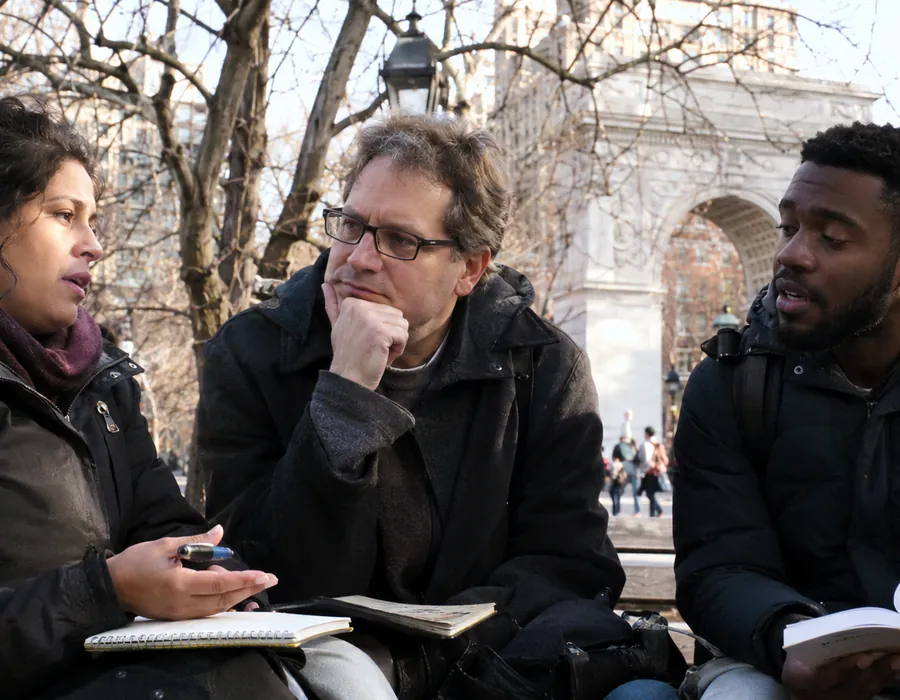 Language exchangeA friendship circle for language exchange in New York: practise English, Arabic, Spanish or another language over coffee, and help someone with yours.
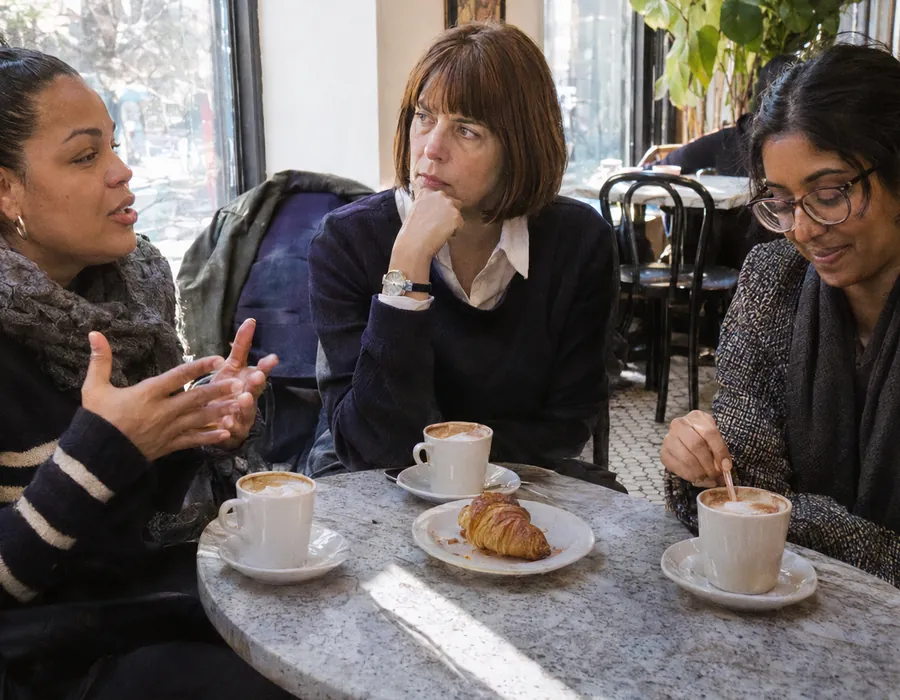 Coffee & conversationA friendship circle for people who enjoy cafés and unhurried conversation in New York. Low-pressure first meetings in small groups, close to home.
Where to meet in New York
Public places picked for small groups of 3 to 10, sorted by interest and area.
Keep reading
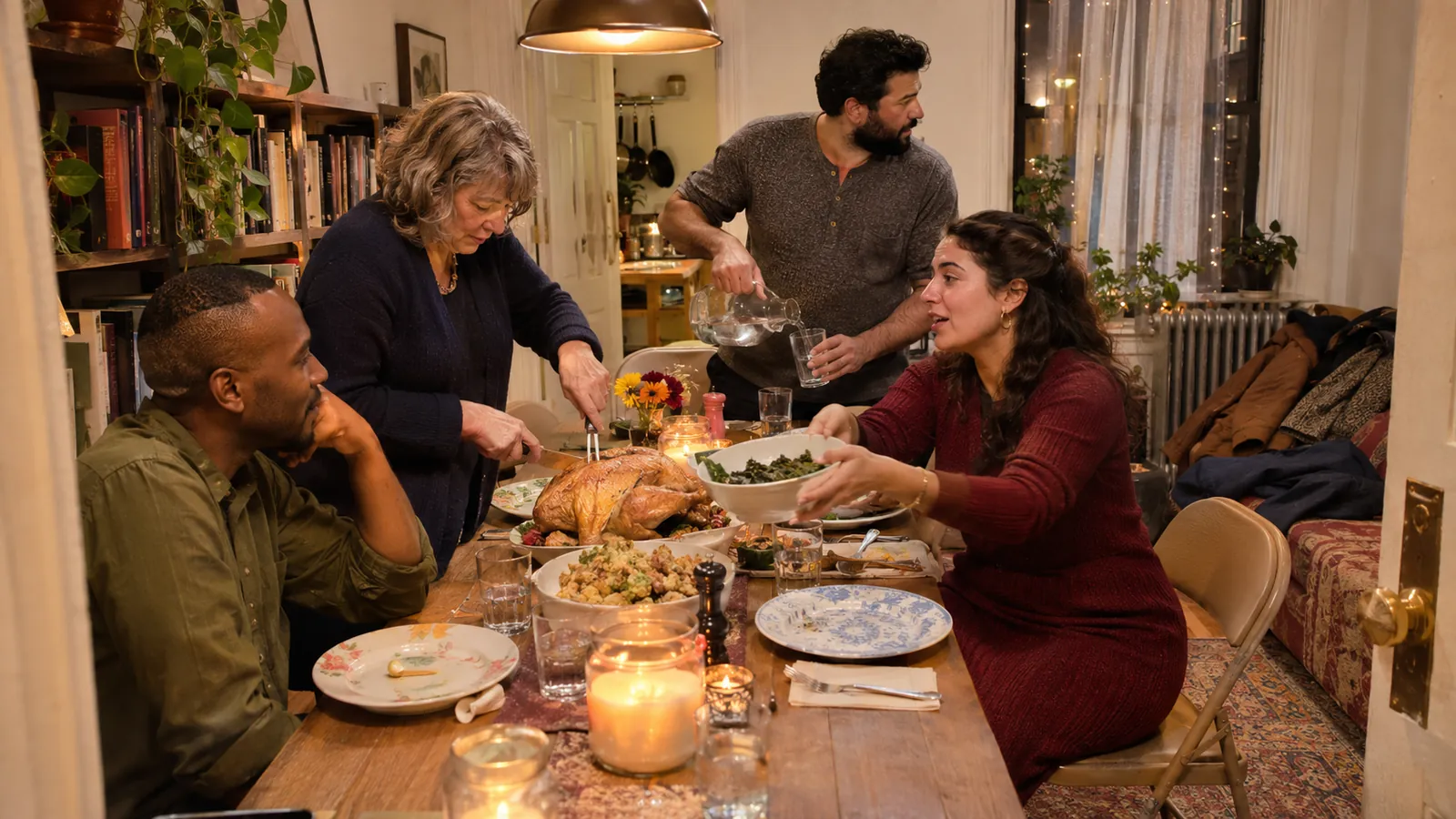 FriendshipFriendsgiving in New York: how to spend Thanksgiving with friends when your family is far away
 IdeasWinter in New York with friends: ice skating, holiday markets and the plans that make the cold months the friendliest of the year
 IdeasPet lovers in New York: how dog runs, park mornings and shelters bring animal people together
 IdeasBook lovers in New York: how the city’s libraries and bookshops turn readers into friends
 IdeasRunning with friends in New York: how Prospect Park and the Hudson River Greenway turn early miles into friendships
 FriendshipMaking friends in New York in your 30s and 40s: when the old crowd drifts away
 IdeasBrooklyn Bridge, DUMBO and the waterfront: New York photo walks with friends
 FriendshipMaking friends in New York as a woman: finding your people in a city of millions
 IdeasFood halls and neighbourhood food in New York: how sharing a table builds friendships
 IdeasNew York museums with friends: why the city’s great galleries are better in a small group
 IdeasCentral Park and the best walks in New York to share with friends
 New in townNew in New York: how to build a social life in your first months
 FriendshipHow to make friends in New York as a grown-up
 NewsTruFriend is now open in New York