Salma had lived in Cairo all her life and, she admitted with some embarrassment, had walked Al-Muizz Street only once, on a school trip when she was twelve. She remembered heat, a teacher counting heads and very little else. Old Cairo was something she drove past on the way to somewhere else. It belonged to tourists and to postcards, not to her ordinary week.
Then a colleague who had recently moved from Aswan asked her, almost shyly, whether she knew anyone who might want to walk the old city with him. He had a camera he barely used and a long list of mosques he had read about. Salma said she would come, and brought a cousin and a friend from university. Four people met at Bab al-Futuh one Friday morning. They meant to stay two hours and stayed seven. By the time they sat down to eat in the evening, they were planning the next walk. Salma says she discovered two things that day: a city she thought she knew, and three people she now cannot imagine her weekends without.
A street that tells a thousand years
Al-Muizz li-Din Allah Street, usually just called Al-Muizz or El Moez, runs through the heart of historic Cairo, a district listed by UNESCO as a World Heritage Site. It dates back to the founding of Cairo under the Fatimids more than a thousand years ago, and walking it from north to south is like turning the pages of a history book written in stone. At the northern end stand the great gates of Bab al-Futuh and Bab al-Nasr, part of the old city walls. Further south comes the Mosque of Al-Hakim, then a remarkable run of Mamluk buildings, including the Qalawun complex and the madrasa of Sultan Barquq, their domes and minarets crowding the sky.
Just off the main street is Bayt al-Suhaymi, an old Ottoman-era house with a shaded courtyard and intricate mashrabiya screens, a quiet place to imagine how Cairene families once lived. Continue south and the street eventually reaches Bab Zuwayla, another of the old gates, whose twin minarets have watched the city for centuries.
You do not need to be a historian to enjoy any of this. The beauty is visible to anyone who looks up. But walking with others changes how much you see. One friend notices the carving above a doorway, another reads aloud from a guidebook, a third simply points at the light falling across a courtyard. Each person brings a different pair of eyes, and the street becomes richer for it.
There is also something about discovering a place together that bonds people quickly. When you stand in a courtyard and all fall silent at the same moment, or climb a few steps and turn to find the same view, you share something that cannot quite be put into words. Weeks later, someone in Salma’s group only has to say “the Qalawun dome” for everyone to smile. Shared wonder, it turns out, is one of the quickest ways strangers find common ground.
Khan el-Khalili and the art of getting lost
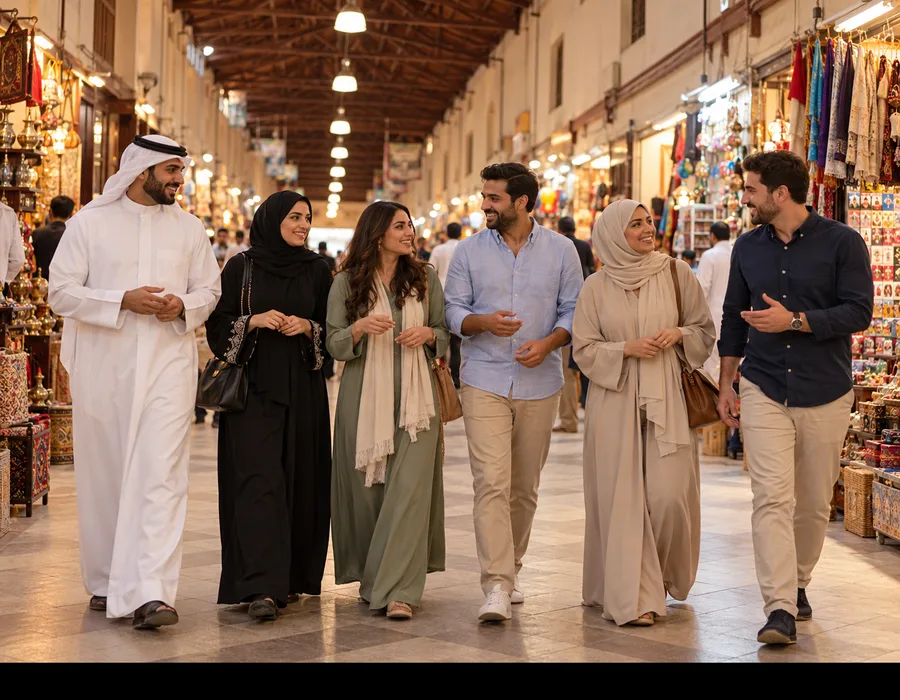
Halfway along Al-Muizz, the lanes open into Khan el-Khalili, the great bazaar that has drawn traders and visitors for centuries. Lamps, copperware, spices, textiles, perfume bottles and silver fill the narrow passages, and the calls of shopkeepers follow you round every corner. It can be overwhelming alone. In a small group, it becomes a game. Someone finds a lamp they love, someone else bargains politely on their behalf, and everyone laughs when they realise they have walked in a complete circle.
Across the square stands Al-Azhar Mosque, one of the oldest and most important centres of learning in the Islamic world. Visitors are welcome outside prayer times, provided they dress modestly and respect the space. Many groups find that a quiet few minutes in its courtyard, after the noise of the bazaar, is one of the moments of the day they remember most.
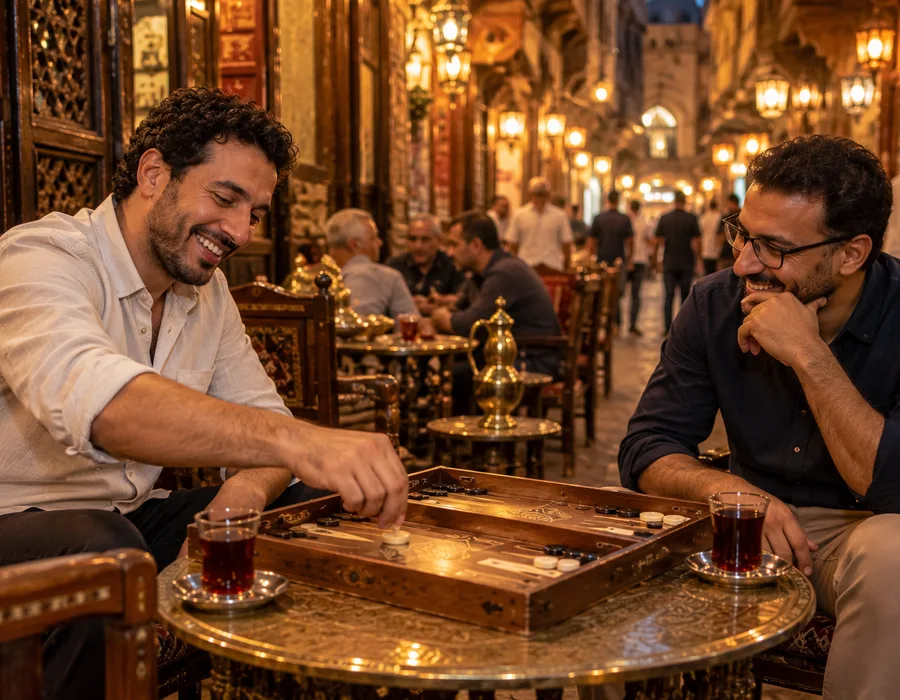
And of course there are the cafés. El Fishawy, tucked into an alley of the Khan, is perhaps the most famous café in Cairo, with its mirrors, its old wooden furniture and its long history. Stopping there for mint tea, or at any of the small cafés nearby, gives the group a chance to rest, look through photos and decide what comes next.
Photos, and why a group takes better ones
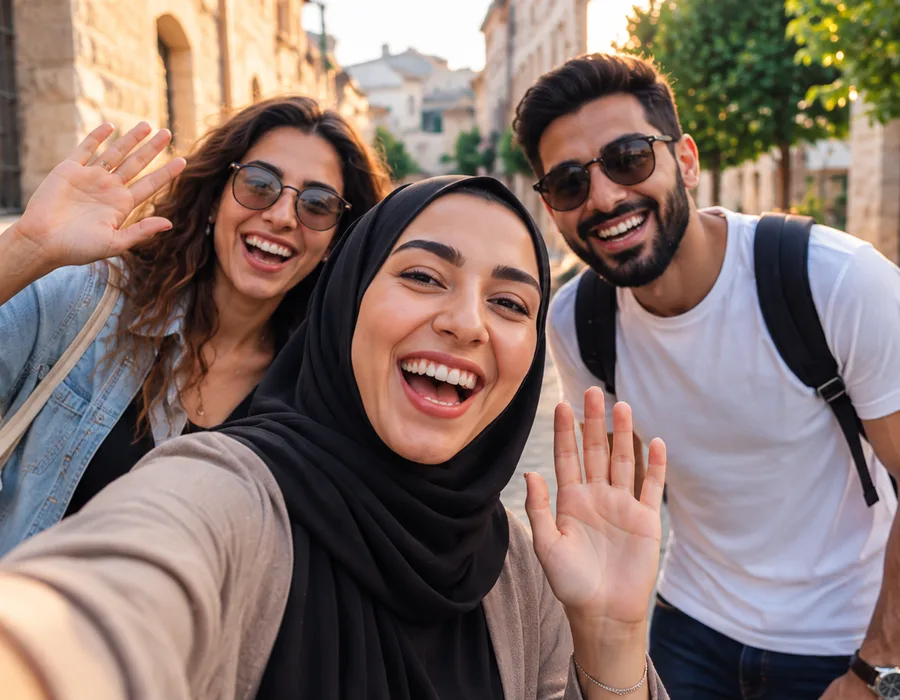
Old Cairo is a photographer’s dream: arches framing minarets, lamplight in narrow lanes, doorways layered with centuries of colour. Salma’s colleague, the one from Aswan, finally used his camera properly that day, and has since become the unofficial photographer of their group.
Photo walks work beautifully as a way to make friends because they give everyone a shared task. You stop together, you look together and you show each other what you have found. Beginners learn from those with more experience, and people who are quiet in conversation often turn out to have the sharpest eye. A simple courtesy goes a long way here: ask before photographing people, especially shopkeepers and families, and respect anyone who says no. Inside mosques, follow the guidance of those who look after them.
Food is part of the walk
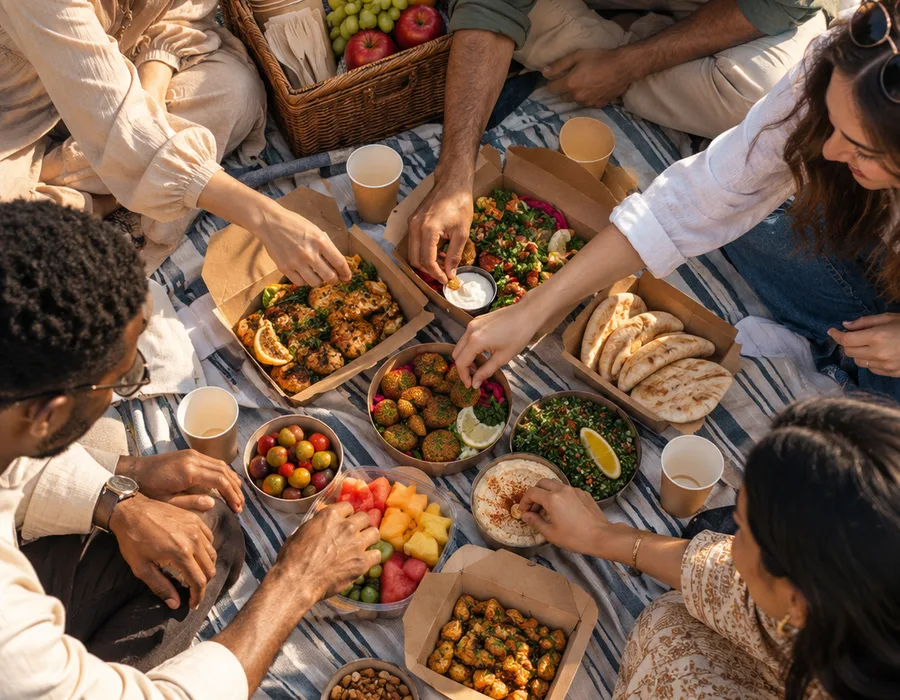
No day in old Cairo is complete without eating, and eating is one of the oldest ways to turn companions into friends. Around Al-Azhar and the surrounding streets, you will find the classics of Egyptian food: ful and ta’meya in the morning, koshari at lunch, fiteer, grilled meats and sweets like basbousa and konafa later in the day. A small group can share several dishes and taste more than any one person could manage alone.
Sharing food also creates the easy, warm conversation that sightseeing alone does not. Over a table of plates, the talk moves from what you saw to who you are. Salma’s group has a tradition now: whoever chose the route chooses the restaurant, and everyone else has to try at least one dish they have never eaten before.
Ending at Al-Azhar Park
A short distance east of the old city lies Al-Azhar Park, one of the great success stories of modern Cairo. Opened in 2005, it was created on land that had been a vast mound of rubble for centuries, and is now a green oasis of gardens, fountains and walkways. From its hills you can see the Citadel of Salah al-Din, the domes and minarets of the historic city and, on a clear evening, a long sweep of Cairo stretching away into the haze.
It is the perfect place to end a day of walking. After hours on stone streets, the grass and open sky feel restful, and the view lets you trace the route you have just walked. Families picnic, friends sit on the lawns and the call to prayer drifts up from the old city below as the light fades.
Making a day of it, safely and comfortably
A few practical habits make the day easier. Start early, especially in the warmer months, and carry water. Wear comfortable shoes, because the old streets are uneven and you will walk much further than you expect. Dress modestly, which is respectful in a historic religious district and makes entering mosques simple. Agree on a meeting point in case anyone gets separated in the Khan, and keep the group small enough to move together through narrow lanes, ideally between four and eight people.
Where TruFriend fits
The hardest part of a day like Salma’s is often finding the people to share it with. That is what TruFriend is for. It is an invite-only platform for friendship only, for grown-ups aged 18 and over, and it is now open in Cairo. Tru, our assistant, learns what you enjoy and when you are usually free, then introduces you to a few compatible people nearby. A conversation only opens when both of you say yes, and every plan takes place in a public place, like the busy streets of the old city.
The Art and culture circle brings together people who love history and architecture, Photo walks is for anyone who wants to explore with a camera, and Food explorers is for those who believe the best way to know a city is through its kitchens. Groups are small, from three to ten people, so you walk with the same faces again and the day out becomes a friendship.
Salma has now walked Al-Muizz more times than she can count, and still finds something new each time. If you would like to discover old Cairo with friends, request an invite and we will send you a personal invitation.
Don’t just read about it
Join a circle of people in Cairo who enjoy the same things. Members already on TruFriend can join from the app or suggest a plan in any chat.
 Art & cultureA friendship circle for galleries, museums, cinema, theatre and live music in Cairo. Find people to see shows and exhibitions with.
 Photo walksA friendship circle for photographers of every level: explore Cairo’s historic streets, the Nile and the city skyline together.
 Food explorersA friendship circle for people who love trying new restaurants, traditional Egyptian dishes and food from around the world in Cairo.